Fire Damage Restoration Phoenix AZ
A house fire is disorienting. Displacement, insurance calls, and salvaging belongings all happen at once. Our team handles the full recovery process, from emergency board-up to final reconstruction. We restore your property safely following strict IICRC S700 standards.
Our Process: The IICRC S700 Sequence
Board-Up, Tarping & Security
Immediate stabilization of the structure to prevent unauthorized entry, theft, or further weather damage from monsoon storms.
Pre-Cleaning & Debris Removal
HEPA vacuuming of loose soot before wet cleaning begins. This prevents smearing oily residue deeper into porous surfaces.
Chemical Selection by Residue Type
We match alkaline cleaners for synthetic/oily residue, enzymatic cleaners for protein-based residue (kitchen fires), and solvent-based for fuel/oil residue.
Structural Cleaning, Top-Down
Ceilings are cleaned before walls to avoid re-contaminating lower surfaces. Every inch is addressed to remove soot and smoke particles.
Contents Cleaning & Pack-Out
Restorable items are separated from non-restorable ones per protocol, cleaned in a controlled environment, and safely stored.
HVAC Decontamination
Full duct cleaning per NADCA ACR standard, including filter replacement and coil cleaning to prevent smoke odor recirculation.
Odor Treatment
Sequential treatment using hydroxyl generators, ozone, or thermal fogging to break down odor molecules at the source.
Sealing & Encapsulation
Finally, we seal smoke-affected surfaces with a shellac-based primer before repainting. Regular paint over unsealed soot will bleed through over time, so this step is critical.
Full-Spectrum Fire Recovery
Smoke Odor Removal
Molecular breakdown of smoke particles using hydroxyl and ozone treatment.
DetailsStructural Repair
Full reconstruction of fire-damaged framing, drywall, and roofing systems.
DetailsBoard-Up & Tarping
Immediate 24/7 security and weather protection for exposed structures.
Contents Cleaning
Pack-out and storage for salvageable personal belongings during rebuild.
Post-Fire Water Cleanup
Addressing damage from firefighting hoses and sprinkler systems.
Air Quality Restoration
HEPA filtration and air scrubbing to remove soot and particulates.
Why This Matters in Phoenix
Fire damage often creates a secondary water damage problem from firefighting efforts. Acting quickly on both fronts—not just the visible fire damage—prevents mold and further structural issues.
Board-up and tarping urgency is critical given monsoon storms can follow shortly after a fire and cause additional damage to an exposed structure. Our team understands these local seasonal risks.
Safety & Regulations
Pre-1980 Home Safety
For homes built before 1980, any demolition or major material removal follows required asbestos testing before disturbance — fire damage often means more demolition than a typical water job, so this matters more here.
Heat-Safety Protocols
Phoenix regularly gets hot enough in summer that extended unprotected work isn't safe. Our team schedules work around the heat and takes regular breaks — this is a genuine safety practice, not just a talking point. Board-up and exterior fire damage assessment often happen outside in direct heat, so these rules are strictly followed.
Equipment & Standards
Our crews follow the IICRC S700 standard. We utilize FSRT-certified technicians, HEPA air scrubbers, thermal fogging equipment, and NADCA-aligned duct cleaning.
Certifications
- IICRC Certified Firm
- FSRT Certified Technicians
- AZROC
What It Typically Costs
| Scope | Typical Range |
|---|---|
| Overall fire damage restoration | $3,100–$52,000+ |
| Smoke damage restoration | $200–$1,200/room |
| Soot removal | $325–$4,500+ |
| Structural fire repairs | $3,200–Market Value |
| Firefighting water damage | $1,000–$9,000 |
| Air duct cleaning post-fire | $250–$700 |
Example Project: Kitchen Fire Restoration in Cave Creek
This is an illustrative example showing how a typical project like this comes together — costs, timelines, and photos are representative of real Valley jobs, not a specific completed job.
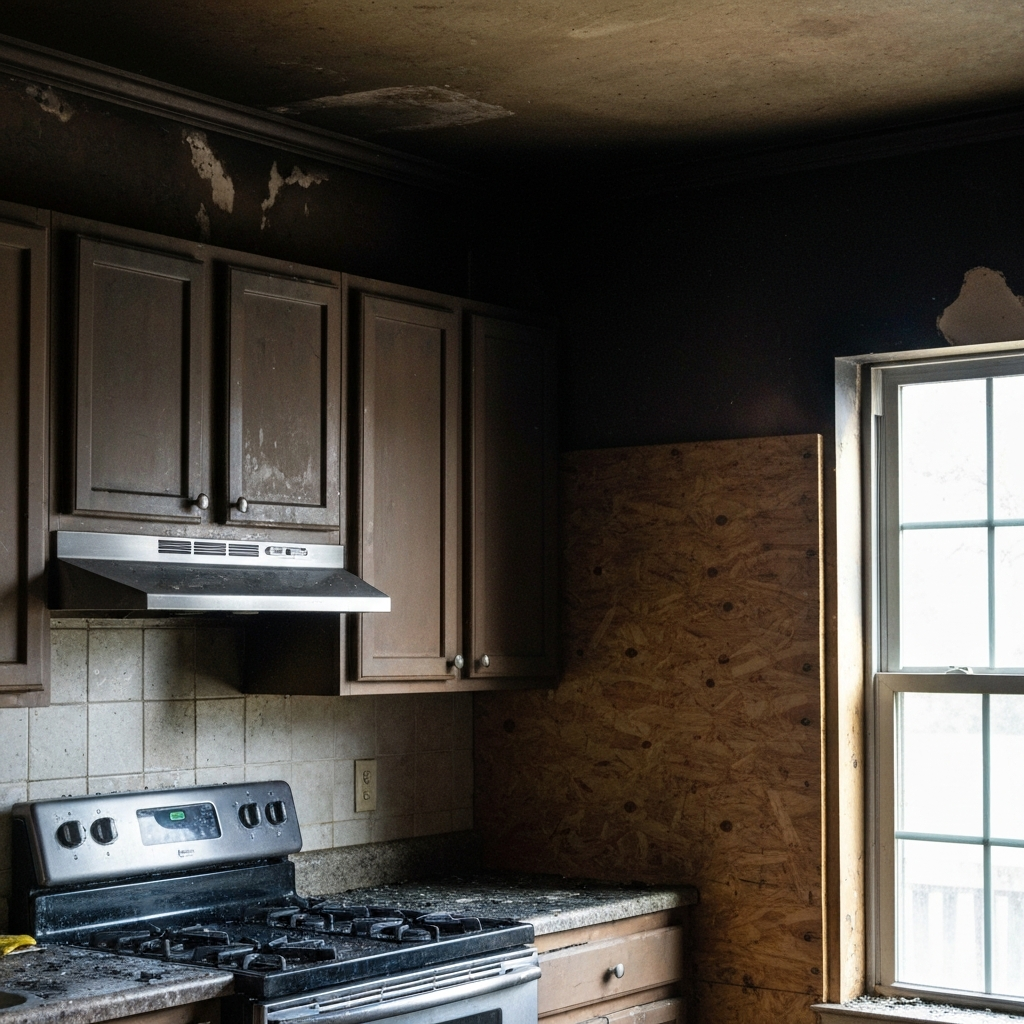
Example only — illustrative rendering, not a photo of a completed job.
The Home
A Cave Creek home where a stovetop grease fire damaged kitchen cabinetry and left soot across the ceiling and adjoining hallway before the homeowner extinguished it.
How We Built the Estimate
- On-site inspection and board-up/tarping assessment to stabilize the structure and secure the home.
- Determined chemical treatment approach by residue type — a grease fire produces protein-based residue, which needs an enzymatic cleaner rather than the alkaline or solvent-based products used for other fire types.
- Assessed contents for restorable versus non-restorable items during pack-out.
- Flagged HVAC decontamination as necessary, since smoke had traveled through a nearby return vent.
- Written, itemized estimate — broken into stabilization, cleaning, and HVAC/odor categories, not a single lump number.
Cost Breakdown (Example)
| Line Item | What's Included | Estimated Cost |
|---|---|---|
| Board-up & pre-cleaning | Stabilization, HEPA vacuuming of loose soot | $600 |
| Structural cleaning | Enzymatic cleaning, top-down, ceiling and cabinetry | $2,400 |
| HVAC decontamination & odor treatment | Duct cleaning, sealing/encapsulation | $1,300 |
| Total (example) | $4,300 | |
Overall fire damage restoration ranges widely, $3,100-$52,000+, depending on how much is structural versus smoke-only — this example landed on the lower-middle end since the fire stayed contained to the kitchen and didn't spread structurally.
The Process
Boarded up and stabilized the affected window and immediate area.
HEPA vacuumed loose soot before any wet cleaning began, to avoid smearing residue deeper into surfaces.
Selected an enzymatic cleaner matched to the protein-based grease-fire residue.
Cleaned top-down — ceiling before walls and cabinetry — to avoid re-contaminating already-cleaned surfaces.
Decontaminated the HVAC system, since smoke had traveled through the nearby return vent and would otherwise recirculate.
Sealed smoke-affected surfaces with a shellac-based primer before repainting, since standard latex paint over unsealed soot will bleed through over time.
Timeline (Example)
| Day | Activity |
|---|---|
| Day 1 | Board-up, pre-cleaning, chemical selection |
| Day 2-3 | Structural cleaning, top-down |
| Day 4 | HVAC decontamination and odor treatment |
| Day 5 | Sealing and final walkthrough |
Contents pack-out and reconstruction, if needed, run as separate phases outside this timeline.
Why It Was Worth Doing
Matching the cleaning chemical to the actual residue type — enzymatic for this grease fire rather than a generic all-purpose cleaner — is what actually lifted the soot instead of just smearing it. Skipping the HVAC step would have left smoke odor circulating through the house indefinitely.
Transparent Pricing & Insurance Support
Our team documents fire and smoke damage thoroughly to support insurance claims from the first visit. We provide a written, itemized cost breakdown before any work starts, so you never have to worry about surprise add-ons.
We accept all major credit/debit cards, cash, check, and insurance claims.
Call Our Team: (480) 568-6410Frequently Asked Questions
Restore Your Property Safely
Serving homeowners and businesses across the Phoenix Valley since 2026. Our team is ready to guide you through every step of fire recovery.
Request Service